
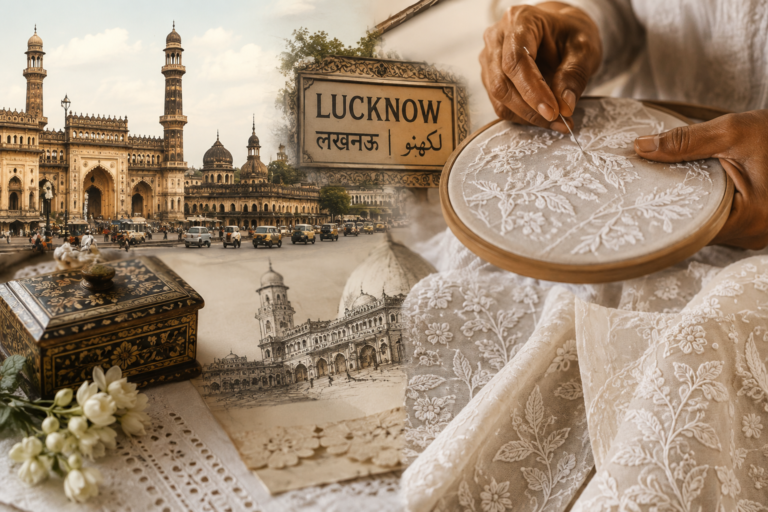
There are some forms of clothing that are beautiful because of the way they look. Then there are those that carry something more: a sense of place, history and human skill. Lucknow Chikankari belongs to the latter. Delicate, intricate and unmistakably graceful, this traditional embroidery has travelled from the quiet lanes of Lucknow to wardrobes across India and beyond, yet it has never lost its connection to the city where its story took root.
Often recognised by its fine white-on-white embroidery, Chikankari is far more than a decorative technique. It is a reflection of Lucknow’s cultural character, shaped by centuries of craftsmanship and refined through generations of artisans. To understand Lucknow Chikankari is to look beyond the finished garment and appreciate the city, the hands and the traditions that brought it to life.
The Story Begins in Lucknow
Lucknow, the capital of Uttar Pradesh, has long been associated with refinement. Its architecture, cuisine, poetry, music and etiquette have all contributed to a distinctive cultural identity often described through the idea of tehzeeb, a sense of grace, courtesy and sophistication.
Chikankari fits naturally into this cultural landscape. Its beauty is rarely loud. Instead, it lies in subtle details, delicate patterns and patient craftsmanship. The embroidery reflects an aesthetic that values restraint and elegance, making it equally relevant to traditional attire and contemporary wardrobes.
The exact origins of Chikankari are often surrounded by different historical accounts. One popular story attributes its introduction to Mughal influence, while other traditions suggest that forms of embroidery were already practised in the region. What is clear is that Lucknow became the centre of Chikankari as the craft developed, evolved and gained recognition over generations.
The city’s artistic heritage played an important role in this journey. Under the patronage of the Mughal court and later the Nawabs of Awadh, fine crafts flourished in the region. Chikankari gradually developed its own distinctive identity, becoming closely associated with Lucknow and its surrounding areas.
What Makes Chikankari Different?
At its heart, Chikankari is an embroidery tradition based on delicate handwork. Traditionally, designs are first transferred onto fabric, after which artisans create intricate patterns using a variety of stitches.
The craft is known for its lightness and delicacy. Floral motifs, leaves, vines, paisleys and geometric details are among the patterns commonly found in Chikankari. These elements are often inspired by nature, creating a visual language that feels graceful rather than elaborate.
One of the most recognisable features of traditional Chikankari is its use of texture. Some stitches create raised details, while others form subtle patterns within the fabric. The result is embroidery that invites a closer look. From a distance, a garment may appear simple. Up close, its craftsmanship becomes much more apparent.
The Beauty of the Stitches
Chikankari includes a wide vocabulary of stitches, each contributing a different texture and character to the final design. Some create fine linear details, while others add depth and dimension.
Among the traditional stitches are Bakhiya, known for its delicate shadow work, Phanda, which creates small knot-like details, and Jali, a fine open-work technique that resembles delicate netting. Other stitches, such as Keel Kangan, Murri and Jaali, add variety to the intricate patterns.
The combination of these techniques allows artisans to create designs that are visually rich without appearing heavy. This balance is one of the reasons Chikankari continues to appeal to modern tastes.
The Craft Behind Every Garment
The finished garment can make Chikankari appear effortless, but the process behind it is anything but simple.
Traditional Chikankari involves multiple stages. The process generally begins with selecting and preparing the fabric. A design is then transferred onto the material, providing the artisan with a guide for the embroidery. Skilled embroiderers carefully work over these patterns, using individual stitches to build the final design.
Once the embroidery is complete, the fabric is washed to remove the temporary design markings and then finished for use. Depending on the garment and the level of detailing, the entire process can involve considerable time and precision.
This is where the human element of Chikankari becomes particularly important. Machine embroidery may reproduce certain visual effects, but traditional hand embroidery carries the individuality of the person who created it. Slight variations in stitches and texture are not imperfections. They are part of the character of handmade craftsmanship.
From Traditional Craft to Contemporary Wardrobes
One of the most remarkable aspects of Chikankari is its ability to adapt.
Traditionally associated with garments such as kurtas, saris and dupattas, Chikankari has gradually found its way into contemporary silhouettes. Today, the embroidery can be seen on dresses, co-ord sets, tops, jackets and a wide range of modern ethnic wear.
This evolution has allowed the craft to remain relevant without completely losing its identity. The embroidery may appear on pastel fabrics, vibrant colours or contemporary cuts, but the underlying visual language remains recognisable.
The popularity of Chikankari also reflects a broader appreciation for clothing that combines cultural heritage with everyday practicality. A well-made Chikankari kurti, for example, can move effortlessly between different settings. It can be styled simply for a relaxed day or accessorised for a more polished occasion.
This versatility is part of what makes the craft so enduring. It does not demand that tradition and modernity exist separately. Instead, it allows the two to coexist.
Why Lucknow Matters to the Craft
Although Chikankari is now recognised across India, Lucknow remains central to its identity. The craft is deeply connected to the city’s cultural landscape and the communities that have preserved its techniques.
For many artisans, embroidery is not simply an occupation. It is a skill passed through generations, carrying knowledge from one pair of hands to another. The continuity of this tradition depends on the people who practise it, as well as on the consumers who value and support craftsmanship.
Understanding this context changes the way we see a Chikankari garment. It becomes more than a piece of clothing. It represents a relationship between craft and culture, between an artisan’s skill and a wearer’s appreciation.
At the same time, the craft faces challenges. Changing consumer preferences, pressure on prices and the growth of machine-made alternatives can affect traditional artisans and handmade production. Supporting authentic craftsmanship and making informed choices can therefore play a role in helping heritage techniques remain relevant.
Wearing a Piece of Living Heritage
The appeal of Chikankari lies partly in its ability to feel both familiar and fresh. Its roots may be deeply traditional, but its understated elegance allows it to adapt to the way women dress today.
Perhaps that is why it continues to hold such a special place in Indian fashion. It is not tied to one particular age group or occasion. It can be graceful without being formal, detailed without being overwhelming and traditional without feeling dated.
When we wear Chikankari, we are not simply wearing embroidery. We are wearing a craft shaped by place, history and human hands. Every stitch carries a quiet reminder of the patience required to create something beautiful, and every garment connects the present to a tradition that has endured through time.
Conclusion
Understanding Lucknow Chikankari means looking beyond its delicate patterns and appreciating the city, culture and craftsmanship woven into its identity. From the artistic heritage of Lucknow to the patient hands of artisans, the craft represents a form of beauty that has remained relevant because it is rooted in something enduring. Its ability to evolve while retaining its character is what allows Chikankari to move naturally from one generation to the next.
At Daur Clothing, this spirit of enduring style inspires a thoughtful approach to fashion, where timeless design, everyday comfort, quality and affordability come together naturally. The finest pieces are not always those that follow every passing trend, but those that continue to feel beautiful, comfortable and meaningful long after the moment has passed. True style, like true craftsmanship, is made to last.