
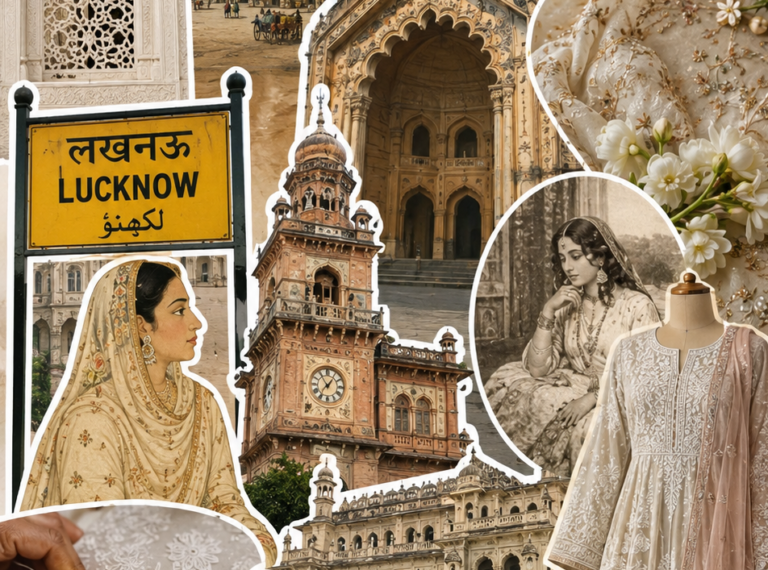
There are cities that are remembered for their monuments, others for their food, music or literature. Lucknow is distinctive because all of these elements seem to exist in conversation with one another. Its grand gateways, ornate buildings, refined traditions, poetic language and celebrated hospitality have shaped a cultural identity that is both sophisticated and deeply rooted in everyday life. At the heart of this world of artistic expression is Chikankari, an embroidery tradition whose quiet beauty reflects much of what makes Lucknow so captivating.
Chikankari is often admired for its delicate threadwork, floral motifs and intricate stitches. Yet to understand its enduring appeal, it helps to look beyond the fabric itself. The craft has developed within a city shaped by centuries of artistic exchange, royal patronage and cultural refinement. From the elegance of Nawabi architecture to the softness of gardens and the graceful traditions of Lucknowi tehzeeb, the environment surrounding Chikankari has influenced the way this embroidery is perceived, practised and cherished.
A City Shaped by Artistic Exchange
Lucknow’s cultural character was strongly shaped during the period when the Nawabs of Awadh established the city as a major centre of art, architecture and refined living. As the city grew in importance, artists and cultural figures associated with the Mughal tradition found patronage in Awadh, contributing to a distinctive cultural environment that combined different influences. The result was a city known for its architectural grandeur as well as its appreciation of craftsmanship and artistic detail.
Chikankari emerged and flourished within this broader atmosphere of artistic appreciation. The craft itself is traditionally associated with delicate hand embroidery, often featuring floral and botanical forms. While its precise origins are surrounded by different historical accounts and legends, its development in Lucknow is closely connected with the city’s cultural history and its long-standing relationship with textile arts.
This connection is important because Chikankari is not simply an isolated decorative technique. It belongs to a wider visual language shaped by the city around it.
The Influence of Lucknow’s Architecture
One of the most striking ways Lucknow inspires Chikankari is through architecture. The city’s historic landscape is filled with arches, domes, gateways, courtyards and ornamental details. Structures such as the Bara Imambara and Rumi Darwaza demonstrate the scale and ambition of the architectural traditions that developed under the Nawabs. Lucknow’s architecture also reflects a blend of Mughal traditions and European influences, creating a visual identity that is both elaborate and distinctive.
The relationship between architecture and embroidery is not always literal. Chikankari does not simply reproduce buildings on fabric. Instead, it reflects a similar appreciation for rhythm, balance and ornamentation.
Look closely at the repeated patterns in an architectural screen or the symmetry of an arch. There is a sense of structure within the decoration. Chikankari works in much the same way. Floral vines may move across a garment in carefully considered arrangements, while open spaces allow the fabric to breathe. The embroidery is decorative, but it is rarely overwhelming.
This balance between ornament and restraint is one of the reasons Chikankari feels so timeless. Like Lucknow’s historic architecture, its beauty often reveals itself gradually rather than demanding immediate attention.
The Poetry of Floral Motifs
Flowers and foliage occupy an important place in Chikankari. Creepers, vines and botanical forms are among its recognisable motifs, with floral imagery reflecting influences that became part of the craft’s visual vocabulary over time. The tradition is known for a wide range of stitching techniques, including flat, embossed and jaali effects, allowing artisans to create variations in texture and depth.
These motifs can also be understood in the context of Lucknow’s broader appreciation for gardens and cultivated beauty. The city’s historic culture has long associated refinement with an appreciation of nature, fragrance and graceful surroundings. In Chikankari, this sensibility is translated into thread.
A vine becomes a border. A flower becomes a repeated motif. A small cluster of leaves creates movement across a sleeve or neckline. What appears simple at first glance can contain remarkable patience and precision.
Nawabi Culture and the Art of Subtle Elegance
Perhaps the strongest connection between Chikankari and Lucknow lies in the idea of refinement.
Lucknowi tehzeeb is widely associated with courtesy, sophistication, gracious living and a distinctive sense of social etiquette. The city’s cultural identity was shaped by traditions that valued language, music, dance, poetry, cuisine and craftsmanship. This appreciation for refinement extended across many aspects of life, creating an environment in which artistry was not treated merely as decoration but as an expression of culture.
Chikankari reflects this sensibility through its restraint. Unlike embroidery that relies heavily on metallic embellishment or intense colour, traditional Chikankari often draws attention through texture, detail and craftsmanship. Its beauty can be quiet.
That quality makes it particularly expressive. The embroidery does not need to dominate the garment to make an impression. Instead, it allows the fabric, silhouette and wearer to remain part of the overall composition.
In this sense, Chikankari mirrors an important aspect of Lucknow’s cultural identity: elegance does not always need to be loud.
From Royal Associations to Everyday Fashion
Over time, Chikankari moved beyond its associations with courtly culture and became part of everyday clothing. Its versatility helped it adapt to changing lifestyles while retaining its essential character.
The craft is traditionally practised on a variety of fabrics, and its techniques can create different visual effects ranging from delicate surface patterns to intricate jaali work. Today, Chikankari appears across a wide range of garments and textiles, from traditional kurtas and kurtis to contemporary fashion.
This evolution demonstrates the resilience of the craft. A tradition survives not by remaining frozen in the past, but by finding relevance in the present.
Modern interpretations may introduce new colours, fabrics and silhouettes, yet the fundamental appeal remains familiar. The handworked quality, floral vocabulary and emphasis on detail continue to connect contemporary clothing with the cultural heritage of Lucknow.
The Human Craft Behind the Embroidery
It is easy to admire Chikankari as a finished garment and forget the human skill behind it. Every stitch represents time, concentration and technical knowledge passed through generations.
The craft’s enduring value lies partly in this relationship between tradition and individual craftsmanship. The same design can carry subtle variations depending on the artisan, the fabric and the technique used. These details give handmade work its character.
Understanding Chikankari in this way also changes how we think about its connection to Lucknow. The city does not inspire the craft only through its monuments or historical associations. It inspires it through the people who continue to practise, adapt and preserve it.
The lanes of Lucknow, its markets and its communities remain part of the living story of Chikankari. The craft belongs not only to museums or history books, but to the everyday cultural life of the city.
Why Chikankari Still Feels Timeless
The most remarkable quality of Chikankari may be its ability to change without losing its identity.
Fashion constantly moves forward, but certain forms of craftsmanship remain relevant because they offer something beyond a passing trend. Chikankari carries a sense of place. Its delicate patterns recall a particular cultural landscape, while its adaptability allows it to fit comfortably into modern wardrobes.
Perhaps that is why its connection with Lucknow remains so powerful. The city itself represents a meeting of influences, traditions and eras. Its architecture combines grandeur with intricate detail. Its culture values refinement without excess. Its artistic traditions embrace history while continuing to evolve.
Chikankari expresses these same ideas in a different medium. It takes the visual poetry of its surroundings and translates it into thread, texture and movement.
Conclusion
The story of Chikankari cannot be separated entirely from the city that helped shape its identity. Lucknow’s art, architecture and culture have created an aesthetic language built on craftsmanship, balance, detail and quiet elegance. From the floral motifs that echo a love of nature to the intricate patterns that recall the rhythm of architectural ornament, Chikankari carries traces of the cultural world in which it flourished.
At Daur Clothing, this enduring connection to heritage inspires a philosophy centred on timeless style, everyday comfort, quality and affordability. The aim is not simply to follow what is fashionable today, but to appreciate clothing that remains meaningful and wearable over time. In the end, true style is often found where heritage meets everyday life, and where timeless craftsmanship continues to feel beautifully at home.