
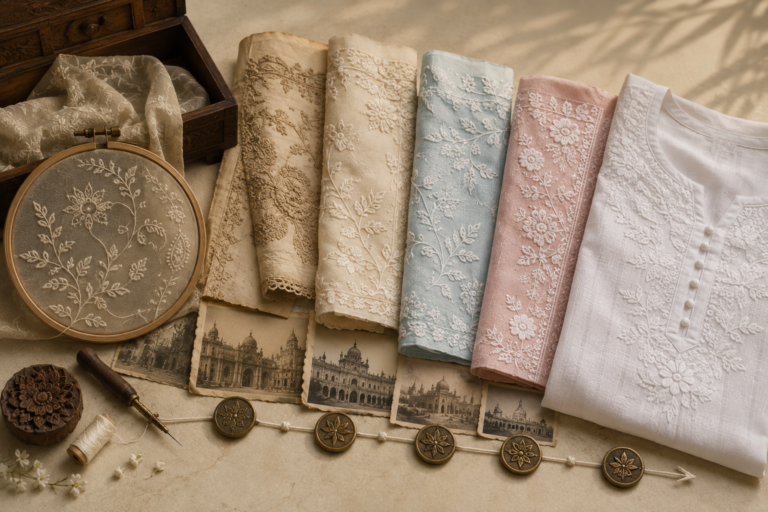
Fashion is constantly moving. Colours change, silhouettes evolve, fabrics come and go, and trends that dominate one season can feel dated the next. Yet, through all these shifts, some forms of craftsmanship continue to hold their place. Chikankari is one of them.
For generations, this delicate form of embroidery has remained deeply connected to Indian clothing and culture. It has appeared on traditional garments, adapted to contemporary wardrobes, and found its way into everyday fashion without losing the character that makes it distinctive. Its survival is not simply a story of preserving an old craft. It is a story of how tradition can evolve without losing its identity.
So, what has allowed Chikankari to remain relevant through changing generations of fashion? The answer lies in a combination of craftsmanship, versatility, cultural connection, and an enduring appreciation for clothing that feels both beautiful and meaningful.
The Story Behind Chikankari
Chikankari is traditionally associated with Lucknow and is recognised for its intricate embroidery, delicate patterns, and understated elegance. The craft is believed to have a long history, with several accounts tracing its development through different cultural influences over the centuries.
While its exact origins are debated, its connection with Lucknow became firmly established over time. The city became an important centre for the craft, and Chikankari developed into an art form closely associated with its cultural heritage.
Traditionally, the embroidery was created by hand, with skilled artisans working patiently on fabric to produce floral motifs, vines, leaves, and other delicate patterns. The beauty of Chikankari has always been in its subtlety. Rather than depending on excessive embellishment, it creates visual interest through fine workmanship.
That quiet quality has helped it remain relevant. Chikankari does not need to compete with every new fashion trend. Its appeal comes from craftsmanship that can be appreciated across generations.
From Traditional Attire to Contemporary Wardrobes
One of the most important reasons Chikankari has survived is its ability to adapt.
Fashion changes not only in appearance but also in the way people live. As lifestyles became faster and wardrobes became more versatile, traditional clothing began to evolve alongside them. Chikankari adapted naturally to this shift.
The craft, once strongly associated with traditional garments, began appearing on a much wider range of clothing. Kurtas, kurtis, suits, dresses, tops, dupattas, and even contemporary fusion pieces brought Chikankari into modern wardrobes.
This flexibility allowed the embroidery to move beyond a specific occasion or age group. It could be worn for a family gathering, a festive celebration, a day at work, or a relaxed outing. The same craft could be interpreted in different ways depending on the garment, fabric, colour, and silhouette.
This is one of the defining strengths of Chikankari. The embroidery remains recognisable, while the clothing around it can change with the times.
Why Its Simplicity Still Feels Modern
Modern fashion often celebrates simplicity. Clean silhouettes, comfortable fabrics, subtle detailing, and versatile pieces have become increasingly important to many wardrobes.
Chikankari fits naturally into this aesthetic.
Its intricate detailing adds character without overwhelming the wearer. A finely embroidered garment can feel elegant without being overly formal. This balance makes it particularly suitable for people who want their clothing to feel special while remaining easy to wear.
The craft also works beautifully with different colour palettes. Traditional white embroidery on soft fabrics has a timeless appeal, while colourful interpretations bring a more contemporary feel. Pastel shades, earthy tones, vibrant colours, and deeper hues can all give the embroidery a different personality.
This ability to exist between tradition and modernity has helped Chikankari remain relevant. It can feel rooted in Indian heritage while still fitting comfortably into the visual language of contemporary fashion.
The Importance of Craftsmanship
At the heart of Chikankari’s longevity is the value of craftsmanship.
In an era when fashion can be produced and consumed at remarkable speed, handmade embroidery offers a different perspective. It represents patience, skill, and attention to detail. Every stitch reflects a process that cannot be entirely separated from the human hand behind it.
The craft also carries knowledge from one generation to another. Techniques, patterns, and methods are passed down through communities of artisans, helping preserve a connection between the past and the present.
This does not mean Chikankari has remained frozen in time. Quite the opposite. Its survival has depended on its ability to evolve while retaining the essence of its craft.
That balance is important. When traditional art forms are allowed to develop alongside changing tastes, they have a better chance of remaining part of everyday life rather than becoming something that is only admired in museums or reserved for special occasions.
Chikankari and the Changing Meaning of Indian Fashion
The way people view Indian fashion has changed significantly over the years.
Earlier, ethnic clothing was often associated with specific cultural occasions, festivals, ceremonies, or formal events. Today, the boundaries between traditional and contemporary dressing are much more fluid.
People increasingly mix elements of Indian and Western fashion, creating wardrobes that reflect individual lifestyles rather than strict categories. A traditional embroidery technique can appear on a modern silhouette, while a classic kurta can be styled with contemporary accessories.
Chikankari has benefited from this shift because it naturally lends itself to interpretation. Its identity is strong enough to be recognised, yet subtle enough to work within different styles.
This has allowed younger generations to discover the craft on their own terms. They may appreciate its cultural history, but they can also choose it simply because they love the way it looks and feels.
That is an important part of how traditions survive. They remain meaningful not only because people remember them, but because new generations continue to find reasons to embrace them.
Why Chikankari Continues to Cross Generations
Perhaps the most remarkable aspect of Chikankari is its ability to connect different generations.
A grandmother may remember it as part of the traditional clothing of her youth. Her daughter may associate it with elegant everyday kurtas or festive dressing. A younger woman may wear it as part of a contemporary wardrobe, pairing it with modern footwear, jewellery, or accessories.
The garment may change, but the underlying appreciation for the embroidery remains.
This continuity is strengthened by Chikankari’s versatility. It can be dressed up or down, styled traditionally or given a contemporary interpretation. It can be delicate and understated or visually striking through colour and design.
It also offers something that many fast-changing trends struggle to provide: familiarity. There is a sense of comfort in wearing something that feels connected to a larger cultural story.
The Future of a Timeless Craft
The future of Chikankari will depend on the same quality that has helped it survive so far: its ability to evolve without losing its essence.
As fashion continues to change, new fabrics, silhouettes, colours, and styling preferences will inevitably emerge. Chikankari will likely continue to appear in new forms, reaching audiences who may experience the craft differently from previous generations.
At the same time, preserving the integrity of the craft remains essential. Its future is not simply about making traditional embroidery fashionable. It is about recognising the skill, history, and cultural value behind it while allowing it to remain relevant to modern life.
The strongest traditions are not necessarily those that remain unchanged. They are the ones that can move forward while carrying their identity with them.
Conclusion
Chikankari has survived generations of changing fashion because it offers something that trends alone cannot provide. It combines craftsmanship with versatility, cultural heritage with contemporary expression, and delicate beauty with everyday wearability. Its enduring appeal lies in this balance, allowing each generation to interpret the craft in its own way while still feeling connected to the generations that came before.
For Daur Clothing, this understanding of fashion reflects a broader philosophy of choosing pieces that feel timeless, comfortable, well made, and accessible. Chikankari continues to remind us that true style does not have to chase every new trend. Sometimes, the most enduring fashion is simply the kind that remains beautiful, wearable, and meaningful over time.