
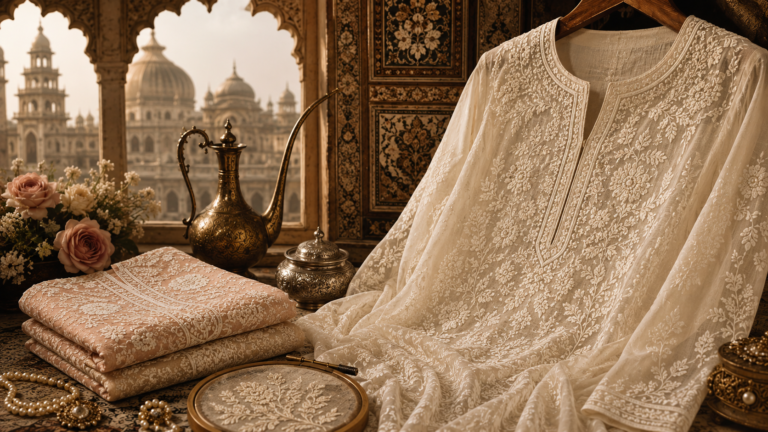
Few forms of Indian embroidery carry the quiet elegance and cultural depth of Chikankari. Known for its delicate white-on-white embroidery, intricate stitches and graceful motifs, this centuries-old craft has become synonymous with the refined aesthetic of Lucknow. Yet behind every finely embroidered flower, vine and paisley lies a fascinating history shaped by artistic traditions, royal patronage and the sophisticated culture of the Nawabi era.
The story of Chikankari is not simply about beautiful clothing. It is also a story of craftsmanship, social influence and changing ideas of elegance. During the Nawabi period in Awadh, embroidery flourished as an important part of the region’s cultural identity. Under royal influence, Lucknow developed into a centre of art, poetry, music, architecture and refined living, creating an environment in which intricate textile crafts could thrive.
Understanding Chikankari through the lens of the Nawabi era offers a deeper appreciation of why this embroidery continues to feel timeless. Its beauty lies not in extravagance, but in the careful balance between subtle detail and effortless sophistication.
The Origins of Chikankari
The precise origins of Chikankari are surrounded by several historical accounts and traditions. One popular legend attributes its introduction to the Mughal court, while other accounts suggest that forms of white thread embroidery existed in the Indian subcontinent long before it became closely associated with Lucknow.
What is more certain is that the craft developed and flourished in Awadh, particularly in Lucknow, where it became deeply connected with the region’s artistic and cultural heritage. The Mughal influence on Indian textiles, combined with local embroidery traditions, contributed to the evolution of techniques and motifs that eventually became recognised as Chikankari.
The word itself is often associated with the Persian term chakin, referring to delicate patterns created through needlework. Over generations, artisans refined the craft, creating an intricate vocabulary of stitches and designs that gave Chikankari its distinctive character.
Lucknow and the Nawabi Influence
The Nawabi era played a significant role in shaping the cultural environment in which Chikankari prospered. As the capital of Awadh, Lucknow became known for its sophisticated court culture and appreciation of fine craftsmanship.
The Nawabs were prominent patrons of the arts. Their courts attracted poets, musicians, architects, craftsmen and artists, contributing to an atmosphere where beauty and refinement were highly valued. Textiles and clothing naturally became part of this cultural expression.
Fashion during the period was closely connected to ideas of status, grace and etiquette. Clothing was not merely functional. It reflected the wearer’s position, taste and understanding of sophistication. Intricate embroidery, therefore, held particular appeal among those who appreciated the patience and skill involved in producing finely worked textiles.
Chikankari fitted naturally into this world. Its delicate appearance offered elegance without excessive ornamentation, making it particularly suited to the refined sensibilities associated with Nawabi culture.
The Art of Subtle Elegance
One of the most distinctive qualities of Chikankari is its restraint. Unlike heavily embellished textiles covered with metallic thread, sequins or elaborate decorations, traditional Chikankari often relies on the quiet beauty of threadwork.
White thread embroidered onto light-coloured fabric creates a soft, almost ethereal effect. Depending on the stitch and technique used, the embroidery may appear raised, shadowed or delicately textured. The result is a garment that reveals its craftsmanship gradually rather than demanding immediate attention.
This subtlety reflects an important aspect of Nawabi aesthetics. Elegance was often expressed through detail, balance and refinement rather than sheer extravagance. The beauty of a garment could lie in the quality of its fabric, the precision of its embroidery and the delicacy of its design.
In this sense, Chikankari represents a sophisticated approach to fashion. It demonstrates that luxury does not always have to be loud. Sometimes, the finest details are the ones that invite a closer look.
Motifs Inspired by Nature
Nature has always been an important source of inspiration for Indian textile traditions, and Chikankari is no exception. Floral vines, leaves, buds, paisleys and other organic forms frequently appear in its designs.
These motifs are particularly significant when viewed against the artistic traditions of the Mughal and Nawabi periods. Mughal art and architecture often celebrated botanical forms, gardens and stylised representations of nature. The famous Mughal garden tradition, with its symmetrical layouts and abundant floral imagery, influenced artistic expression across many forms.
Chikankari motifs reflect a similar appreciation for nature, though they translate it into a much softer and more intimate medium. A flowering vine embroidered across fabric can create a sense of movement, while small floral details add rhythm and depth to an otherwise understated garment.
The beauty lies in the way these elements are arranged. Rather than overwhelming the fabric, the embroidery works with it, allowing the base material and craftsmanship to exist in harmony.
The Craftsmanship Behind the Embroidery
Traditional Chikankari is a labour-intensive craft that requires considerable skill and patience. The process involves several stages, from preparing the design to transferring patterns onto fabric and carrying out the embroidery by hand.
Artisans use a variety of stitches to create different textures and visual effects. Some stitches form delicate outlines, while others produce filled patterns, raised surfaces or subtle shadow effects. The combination of these techniques allows even a relatively simple motif to acquire remarkable depth.
The human element is central to the craft. Each artisan brings precision, experience and individual skill to the embroidery process. Slight variations in thread tension, stitch formation and detailing can give handmade Chikankari its distinctive character.
This craftsmanship also explains why the embroidery has remained culturally significant. It represents more than decoration. It embodies knowledge passed from one generation to another, preserving techniques that might otherwise disappear in an increasingly mechanised world.
From Royal Courts to Everyday Wardrobes
As cultural and economic circumstances changed, Chikankari gradually moved beyond the exclusive world of courtly fashion. The craft became accessible to a wider audience and evolved alongside changing lifestyles and clothing preferences.
Its adaptability has been one of the reasons for its remarkable longevity. Chikankari can be found on traditional garments such as kurtas, kurtis, suits and sarees, as well as contemporary silhouettes designed for modern wardrobes.
The embroidery itself has also evolved. While classic white-on-white work remains highly admired, Chikankari today appears in a wider range of colours and fabrics. This allows the craft to appeal to different generations while retaining the visual language that makes it recognisable.
What has remained constant is the emphasis on delicacy and craftsmanship. Whether worn for a festive gathering or styled as part of an everyday outfit, Chikankari continues to offer a distinctive way of expressing Indian heritage through clothing.
Why Chikankari Still Feels Timeless
Fashion is constantly changing, yet some crafts remain relevant because their appeal extends beyond passing trends. Chikankari is one such example.
Its enduring quality comes partly from its versatility. A finely embroidered kurti can be styled simply for everyday wear or accessorised for a more formal occasion. The embroidery adds character without limiting how the garment can be worn.
There is also something inherently personal about handmade embroidery. In an age of mass production, the time and skill behind a carefully worked piece create a sense of connection to the craft itself.
Perhaps most importantly, Chikankari represents a balance between heritage and modernity. Its roots may be connected to centuries of artistic traditions and the refined culture of Awadh, but its aesthetic continues to fit naturally into contemporary life.
That balance is what gives it lasting relevance. Chikankari does not need to imitate the past to celebrate it. Instead, it carries elements of history forward through designs that can be interpreted in new ways.
The Living Legacy of Nawabi Elegance
The influence of the Nawabi era can still be felt in the way Chikankari is perceived today. Its association with Lucknow, refinement and intricate craftsmanship has given it a unique place in India’s textile heritage.
Yet its story is ultimately larger than royalty. The survival of Chikankari owes much to the artisans who have preserved its techniques and adapted them across generations. Their work has allowed a craft once admired in elite cultural circles to become part of wardrobes across India and beyond.
Today, every embroidered motif carries a connection to that continuing history. The floral patterns may be delicate, but the tradition behind them is remarkably enduring.
Conclusion
Chikankari’s journey through the Nawabi era reveals why this embroidery has remained such a powerful expression of Indian elegance. Shaped by the artistic traditions of Awadh and influenced by a culture that valued refinement, craftsmanship and beauty in detail, it represents an enduring relationship between heritage and fashion. Its delicate stitches, nature-inspired motifs and understated character continue to remind us that true elegance is often found in what is thoughtfully created rather than what is simply made to impress.
At Daur Clothing, this enduring spirit of Chikankari aligns naturally with a philosophy centred on timeless style, everyday comfort, quality and affordability. The aim is not to preserve tradition in a distant, untouchable form, but to appreciate its beauty and bring it into the rhythm of modern life, creating pieces that feel relevant today while respecting the craftsmanship and cultural legacy behind them. Because the most meaningful style is the kind that remains beautiful, comfortable and valued long after the moment has passed.